Claude Code setup
How I actually run Claude Code
One folder for everything, a repo to coordinate it, a box that keeps running when I close the laptop, and the guardrails that catch mistakes before they ship.
Foundation
One folder, one repo to coordinate it
Every project lives under one folder. A separate ops/ repo tracks the others — which machines exist, which service each dependency lives in, and one card per active project, updated the moment something real changes.
~/dev/
├── project-1/
├── project-2/
├── project-3/
└── ops/
    ├── hosts.md          every machine, how to reach it
    ├── services.md       every dependency, where its key lives
    ├── projects/
    │   ├── project-1.md  stack, deploy step, open items
    │   └── project-2.md
    ├── docs/
    │   └── incidents.md  forensic history, kept separate
    └── claude-config/    symlinked into ~/.claude — next
Config topology
Rules that live in one place, or none at all
- + One edit updates rules, hosts, and service maps everywhere
- + Ops knowledge lives in one place, not scattered per repo
- − Depends on the symlink existing
- − Can't be handed off without carrying the ops repo
- + Fully portable — clone it anywhere, no external dependency
- + Safe to open-source without exposing infra notes
- − Rules must be duplicated by hand, and will drift
- − Loses the habit of routing questions back to one source
Mechanism
What's actually loaded, and when
The baseline is small on purpose. Adding a sixth project adds one more on-demand card, not six more always-loaded files.
In practice
A schema change, three projects away
Task
Change project-1's schema
services.md
"project-2 reads project-1's DB directly"
already documented
Flagged
project-2's dashboard — at risk
Clone and explore project-1's repo — not needed. The coupling was already written down in one of the three always-loaded files.
Persistence
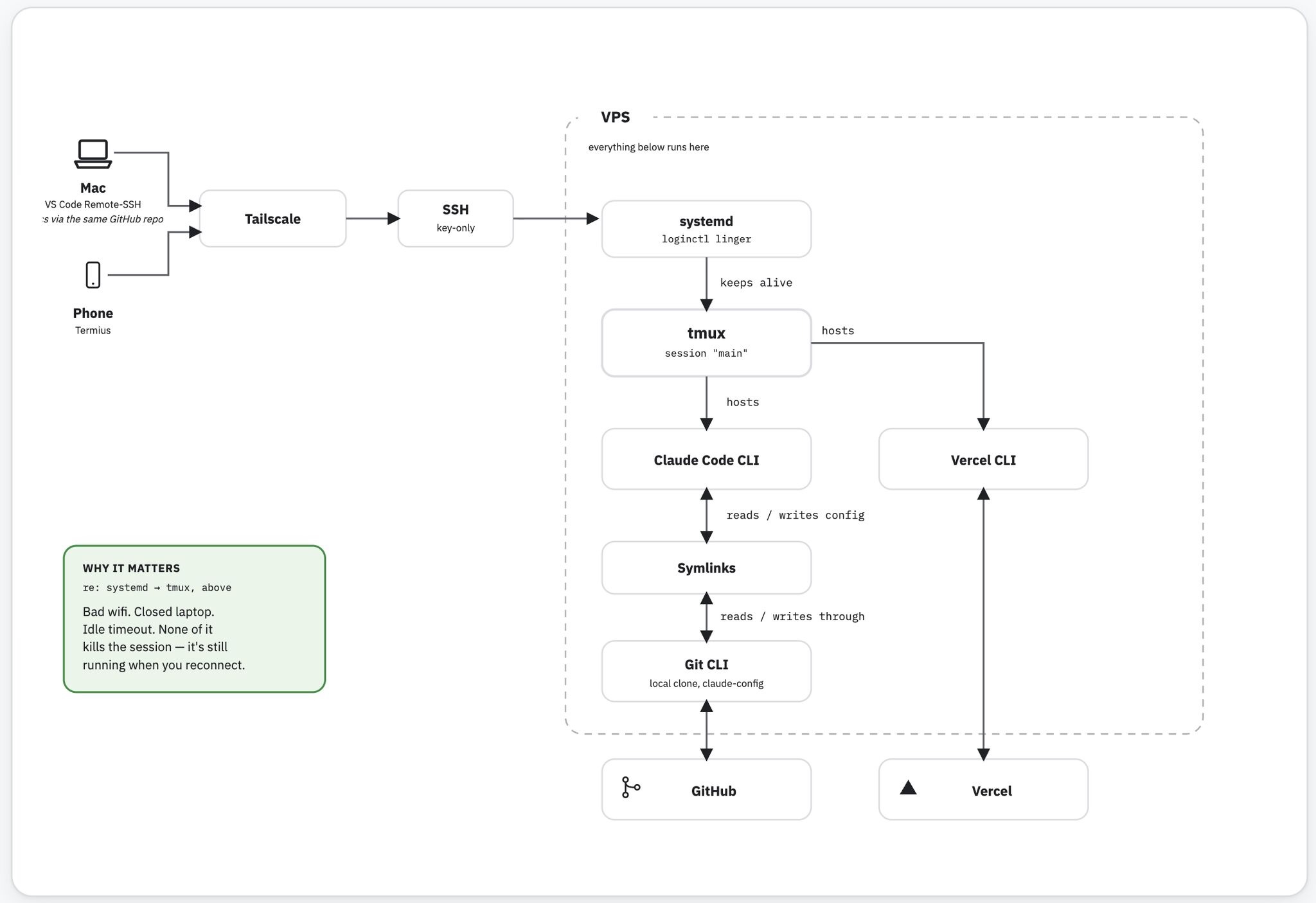
Claude Code that survives disconnection
Memory
Context that survives the session
- User — role, expertise, how they like to work
- Feedback — corrections and confirmed approaches, with why
- Project — who's doing what, kept current, not permanent
- Reference — pointers to where things live, not the content itself
---
name: feedback-example
description: pattern learned from a correction
metadata:
  type: feedback
---

Rule the correction implied, generalized beyond
the one instance.

Why: the reasoning given at the time, so future
edge cases get judged the same way, not re-litigated.
Guardrails
Nothing ships on trust
- ✓Lint, typecheck, and build — automatic, not on request
- ✓No console.log, no empty catch blocks
- ✓No secrets in code, ever
- ✓Every caught exception logged or re-thrown
- ✓All 5 UI states covered before a task is "done"
Changelog
A dated log, not a version number
## 2026-08-21
### Fixed
- Sensitive env var audit — corrected vars that
  should have been marked sensitive

## 2026-08-16
### Changed
- Renamed database to match the project name
Deploy loop
Stops on a failed check. Never ships around one.
$ git push origin main

▸ pull          read-only key, scoped to one repo
▸ build
▸ health check  poll each service's real route
▸ advance       marker moves forward, only on all-pass

3/3 passing → live
Before this existed
What the layering fixed
Commands
The ones I actually reach for
/code-reviewReviews the current diff or a PR, can apply the fixes it finds.
/commitStages, writes the message, commits — same discipline every time.
/loopRuns a prompt on a recurring interval, self-paced, until told to stop.
/scheduleA cron-based agent run for work that doesn’t need a live session.
/reviewReviewer, QA, and security passes in parallel, synthesized into one report.
/security-reviewA full security pass on pending changes before anything merges.
This is the same setup behind every system on this site.